How the Peptide Concentration Calculator Works
Concentration is simply amount divided by volume. Everything else on this page is that one number written in a different unit:
mg/mL = peptide (mg) ÷ volume (mL)
mcg/mL = mg/mL × 1,000
mcg per unit = mcg/mL ÷ 100 (U-100 syringe)
% w/v = mg/mL ÷ 10
mM = mg/mL ÷ molecular weight × 1,000
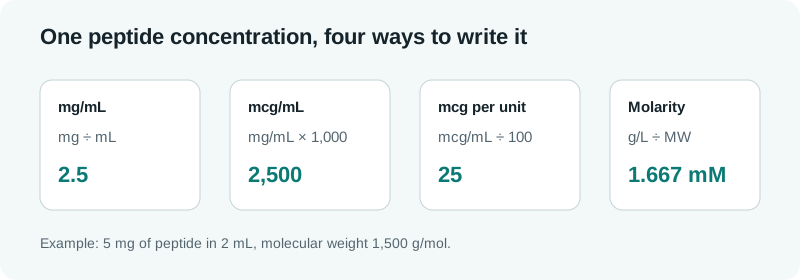
Because it converts between all of these units at once, the tool also works as a peptide conversion calculator or peptide solution calculator for lab stock.
Which Peptide Concentration Unit to Use
mg/mL
The standard label for a reconstituted vial. Write it on the vial so any later dose can be checked.
mcg per unit
The quickest way to read a U-100 syringe: multiply the units you draw by this number to get mcg.
mM and µM
Used in lab work, where assays are planned by molecules rather than mass. These need the peptide's molecular weight.
Peptide Concentration Calculator Example
A 5 mg vial is reconstituted with 2 mL of bacteriostatic water, and the peptide's molecular weight is 1,500 g/mol.
- mg/mL: 5 mg ÷ 2 mL = 2.5 mg/mL.
- mcg/mL: 2.5 × 1,000 = 2,500 mcg/mL.
- Per unit: 2,500 ÷ 100 = 25 mcg per unit, so 10 units hold 250 mcg.
- Molarity: 2.5 g/L ÷ 1,500 g/mol = 0.001667 mol/L = 1.667 mM (1,666.7 µM).
To go the other way and find the units for a set dose, use the main peptide calculator. To choose a water volume that gives a particular concentration before you mix, use the peptide reconstitution calculator.
Peptide Concentration in Molarity
Lyophilized peptide powder is rarely 100% peptide. It also holds counter-ions (often acetate or TFA salts) and some water, so the net peptide content on a certificate of analysis is commonly 70–90%. For an accurate molar concentration, multiply the weighed amount by the net peptide content before entering it. For example, 5 mg at 80% net content is 4 mg of peptide.
Molecular weight is listed in g/mol or daltons (Da); the two are numerically equal. The PubChem database (NIH) lists molecular weights for many published peptides.
Peptide Concentration Chart
Micrograms per U-100 syringe unit for common vial sizes and volumes:
| Peptide | 1 mL | 2 mL | 3 mL |
|---|---|---|---|
| 2 mg | 20 mcg/unit | 10 mcg/unit | 6.67 mcg/unit |
| 5 mg | 50 mcg/unit | 25 mcg/unit | 16.67 mcg/unit |
| 10 mg | 100 mcg/unit | 50 mcg/unit | 33.33 mcg/unit |
| 15 mg | 150 mcg/unit | 75 mcg/unit | 50 mcg/unit |
Need a weaker solution from one you have already mixed? The peptide dilution calculator works out the stock and diluent volumes.
Peptide Concentration Calculator FAQ
How do you calculate peptide concentration?
Divide the peptide amount in mg by the total liquid volume in mL. A 10 mg vial with 4 mL of water is 2.5 mg/mL.
How do I convert mg/mL to mcg per unit?
Multiply mg/mL by 1,000 to get mcg/mL, then divide by 100, because a U-100 syringe holds 100 units per mL. In short, mg/mL × 10 = mcg per unit.
How do I convert peptide mg/mL to molarity?
Divide mg/mL (which equals g/L) by the molecular weight in g/mol to get mol/L, then multiply by 1,000 for mM or 1,000,000 for µM.
Does the powder volume change the concentration?
For the small amounts in a typical vial, the powder adds almost no volume, so the water you add is used as the total volume.
Is the peptide concentration calculator free?
Yes. It is free, needs no account, and runs entirely in your browser.
This peptide concentration calculator performs arithmetic only and is provided for educational purposes. It does not recommend any peptide, dose or protocol. Confirm every dose with a licensed healthcare professional, and read our medical disclaimer and how the formulas are checked.