What Is Bacteriostatic Water?
Bacteriostatic Water for Injection is sterile water containing benzyl alcohol as a preservative. The preservative inhibits bacterial growth; it does not make a contaminated product sterile. Product formulations and labeling vary. The DailyMed product label describes its use as a diluent only according to the medication manufacturer's instructions and includes important restrictions, including for neonates.
How the BAC Water Calculator Works
The first calculator divides an entered mass by an entered liquid volume. The second reverses that equation to solve for a theoretical volume at an entered concentration. The converter changes units without changing the underlying quantity. All calculations happen in your browser; no account is required.
Concentration and Volume Formulas
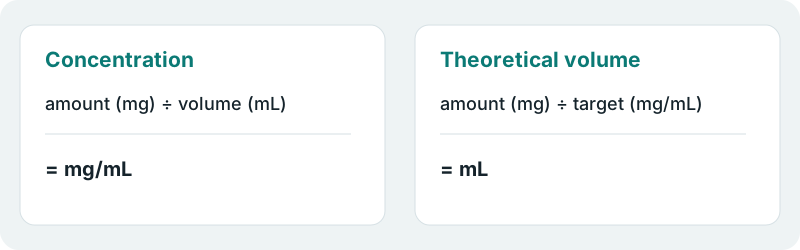
Concentration (mg/mL) = Substance Amount (mg) ÷ Diluent Volume (mL)
Concentration (mcg/mL) = Concentration (mg/mL) × 1,000
Theoretical Volume (mL) = Substance Amount (mg) ÷ Target Concentration (mg/mL)
These equations assume the entered amount represents the relevant mass and that the entered volume represents the final liquid volume. A real product may specify a different final volume after reconstitution. Theoretical volume is not a compatibility, stability, sterility, or safety assessment.
BAC Water vs. Sterile Water
Bacteriostatic water contains a preservative; preservative-free Sterile Water for Injection does not. They are not automatically interchangeable. The medicine's label determines which diluent, if any, is appropriate. For additional unit-focused math, see our concentration calculator or the dilution calculator.
Understanding mg, mcg, and mL
Milligrams (mg) and micrograms (mcg) measure mass: 1 mg equals 1,000 mcg. Milliliters (mL) and microliters (µL) measure volume: 1 mL equals 1,000 µL. A mass cannot be converted directly to a volume without a concentration.
Common Calculation Mistakes
- Using zero or a negative value as a denominator. Division then has no valid result for this tool.
- Confusing mg with mcg or mL with µL, each a 1,000-fold difference.
- Assuming the volume entered equals the final solution volume when a product's label says otherwise.
- Treating an arithmetic result as proof that a diluent is compatible with a medication.
Related reading: the calculator home page, how our calculators are checked and the medical disclaimer.
Frequently Asked Questions
What is BAC water?
BAC water is Bacteriostatic Water for Injection, sterile water with benzyl alcohol as a preservative. Check the specific product label for its composition and restrictions.
What is bacteriostatic water used for?
It can be a diluent for certain medications when the medication manufacturer specifically directs its use. This calculator does not determine whether it is suitable for a particular product.
Is BAC water the same as sterile water?
No. Bacteriostatic water contains a preservative; preservative-free Sterile Water for Injection does not. Follow the medication's diluent instructions.
How do you calculate concentration in mg/mL?
Divide substance amount in mg by final liquid volume in mL. The result has units of mg/mL.
How do you convert mg to mcg?
Multiply mg by 1,000. To convert mcg to mg, divide by 1,000.
Can BAC water be used with every medication?
No. Diluent compatibility depends on the medication and its labeling; benzyl alcohol may be unsuitable in some situations.
Does BAC water prevent all bacterial contamination?
No. Its preservative inhibits bacterial growth but does not guarantee sterility or eliminate contamination risk.