Molarity Calculator Formula
Molarity is moles of solute divided by the final solution volume in litres. Molecular weight converts mass in grams into moles:
M = [mass (g) × net content fraction ÷ molecular weight (g/mol)] ÷ final volume (L)
One M is one mole per litre; 1 mM is 0.001 M, and 1 µM is 0.000001 M. Because 1 mg/mL equals 1 g/L, you can also divide mg/mL by molecular weight to obtain M when net content is 100%.
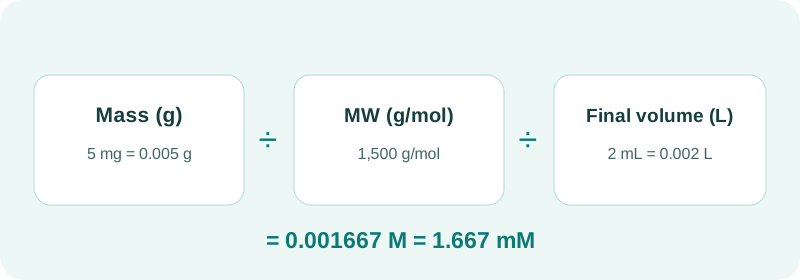
Molarity Calculator Example
For 5 mg of a 1,500 g/mol peptide in a final volume of 2 mL, the concentration is (0.005 g ÷ 1,500 g/mol) ÷ 0.002 L = 0.001667 M, or 1.667 mM. The solution contains 3.333 µmol of peptide. If net content is 80%, use 4 mg as the effective peptide mass; the result becomes 1.333 mM.
Moles to Molarity: Volume Is Required
M = amount of solute (mol) ÷ final solution volume (L)
The “molar to molarity” conversion needs two inputs: an amount in mol, mmol or µmol and the final volume. For example, 2 µmol in 2 mL is 0.001 M, or 1 mM. The same 2 µmol in 4 mL is 0.5 mM. A mole amount without a volume cannot determine a concentration.
Molarity to Moles: Target Amount
amount of solute (mol) = target molarity (M) × final solution volume (L)
A 2 mL solution at 1 mM requires 0.000002 mol, or 2 µmol, of solute. This mode reports mol, mmol and µmol so the result can be compared with a stock amount. If you must weigh powder, multiply the result in mol by its molecular weight in g/mol, then divide by the net content fraction. For a 1,500 g/mol peptide at 100% net content, 2 µmol corresponds to 3 mg; at 80% net content, it corresponds to 3.75 mg.
Concentration Molar Calculator: Unit Conversions
The term “concentration molar calculator” means a tool that reports concentration in moles per litre. This molar concentration calculator accepts grams, milligrams or micrograms for mass; mol, mmol or µmol for amount; and litres, millilitres or microlitres for final volume. It converts these inputs to base units before applying the formula.
Check the units on the molecular weight before calculating. Daltons (Da) and g/mol have the same numerical value for molecular weight. Do not enter a mass concentration such as mg/mL in that field. If you have a peptide sequence but no molecular weight, estimate it with the peptide molecular weight calculator. If you need mg/mL, mcg/mL or U-100 syringe unit conversions, use the peptide concentration calculator. To plan a weaker stock solution from an existing one, use the dilution calculator.
The net solute content field corrects for the fraction of weighed powder that represents the molecule named by your molecular weight. For example, 80% means only 0.8 mg of each 1 mg weighed contributes to the stated solute amount. If your supplier reports several different purity or water measurements, check which one represents net content before using it here. For a general mass and volume calculation without molecular weight, start with the peptide calculator.
Molarity Calculator FAQ
How does a molarity calculator differ from mass concentration?
Molarity counts molecules per litre; mass concentration describes the weight per volume. Molecular weight links the two.
Can I use daltons in the molarity calculator?
Yes. A molecular weight expressed in daltons has the same numerical value as grams per mole.
Which volume should I enter in the molarity calculator?
Enter the final volume of the prepared solution, rather than only the volume of solvent added.
This calculator provides concentration arithmetic for educational and laboratory use. It does not recommend a dose or treatment. See our medical disclaimer.