How to Use the Peptide Dosage Calculator
The tool needs the same three numbers as any peptide dose calculator, plus how often you dose. Everything else is derived from them.
- Vial amount. The total peptide on the label, such as 10 mg.
- Water volume. The bacteriostatic water already in the vial. If you have not mixed it yet, plan that first with the peptide reconstitution calculator.
- Dose. The amount for a single injection, in mcg or mg, exactly as your prescriber wrote it.
- Frequency. From twice daily to once weekly. This drives the vial-supply figures.
- Syringe. The tool flags draws that overflow the syringe or are too small to measure.
The result card shows the units to draw, and the table beneath it lists the units for nearby doses. That table is handy when a dose is being stepped up or down over several weeks.
Peptide Dosage Formula
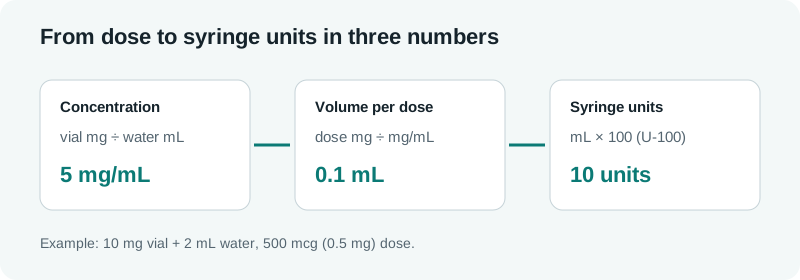
units = dose (mg) ÷ (vial mg ÷ water mL) × 100
Written out, that is three short steps. First find the concentration in mg per mL. Then divide the dose by it to get the volume in mL. Finally multiply by 100 to convert mL into U-100 syringe units. A peptide calculator dosage result is always the volume — never a measure of strength — so the same number of units can deliver different doses from different vials.
Peptide dosage supply math
doses per vial = vial mg ÷ dose mg
days per vial = doses per vial ÷ doses per week × 7
The calculator rounds doses per vial down to whole doses, because a partial final draw is not a full dose. In practice, a little solution is also lost in the needle and the vial's dead space, so it is wise to plan a small margin.
Peptide Dosage Calculator Examples
Daily microgram dose
10 mg vial, 2 mL water, 500 mcg once daily. Concentration is 5 mg/mL, the dose is 0.1 mL or 10 units, and the vial holds 20 doses — about 20 days of supply. Over 30 days you would use 15 mg.
Weekly milligram dose
5 mg vial, 2 mL water, 2.5 mg once a week. Concentration is 2.5 mg/mL, the dose is 1 mL or 100 units, and the vial holds exactly 2 doses. Because a full 1 mL syringe is hard to read at the top, many people use less water for weekly milligram doses.
Small dose, more water
2 mg vial, 1 mL water, 100 mcg. That is just 5 units. With 2 mL of water the same dose becomes 10 units, which is easier to measure accurately.
Peptide Dosage Units Conversion Table
This reference shows the units for common doses at four common concentrations. Find your concentration on the main peptide calculator if you are unsure.
| Dose | 1 mg/mL | 2.5 mg/mL | 5 mg/mL | 10 mg/mL |
|---|---|---|---|---|
| 100 mcg | 10 units | 4 units | 2 units | 1 unit |
| 250 mcg | 25 units | 10 units | 5 units | 2.5 units |
| 500 mcg | 50 units | 20 units | 10 units | 5 units |
| 1 mg | 100 units | 40 units | 20 units | 10 units |
| 2 mg | — | 80 units | 40 units | 20 units |
| 2.5 mg | — | 100 units | 50 units | 25 units |
A dash means the dose would need more than a full 1 mL syringe at that concentration.
Peptide Dosing Calculator Safety Notes
- The calculator does not choose doses. It only converts a dose you already have into units. Dose decisions belong to your prescriber.
- Units are not milligrams. "10 units" means 0.1 mL. Never transfer a unit figure from one vial to another without recalculating.
- Check the unit selector. Confusing mcg and mg is the single most common error, and it is a thousandfold mistake.
- Recalculate after re-mixing. A new vial with a different water volume has a different concentration, even if the peptide is the same.
As a peptide dosing calculator, the tool is only as reliable as the numbers you enter. If a result looks surprising, work it through by hand with the formula above before drawing anything.
Peptide Dosage Calculator FAQ
How do I calculate a peptide dosage in units?
Divide the vial mg by the water mL to get the concentration, divide your dose in mg by the concentration to get mL, and multiply by 100. A 500 mcg dose from 10 mg in 2 mL is 10 units.
How many units is 250 mcg in this peptide dosage calculator?
It depends on the concentration. At 2.5 mg/mL (5 mg in 2 mL) it is 10 units; at 5 mg/mL (10 mg in 2 mL) it is 5 units.
How long will a peptide vial last at my dosage?
Divide the vial mg by your dose to get the number of doses, then divide by your doses per week and multiply by 7 to get days. The calculator does this when you set the frequency.
Is a peptide dose calculator different from a reconstitution calculator?
A dose calculator starts from a mixed vial and gives units. A reconstitution calculator starts from the units you want and gives the water to add.
Does the peptide dosage calculator store my data?
No. All calculations run in your browser and nothing you type is saved or sent anywhere.
This peptide dosage calculator is for educational purposes and performs arithmetic only. It is not medical advice and does not recommend any compound or dose. Always follow a licensed healthcare professional. Read our medical disclaimer and how our formulas are checked. MedlinePlus explains how to give an insulin-syringe injection.