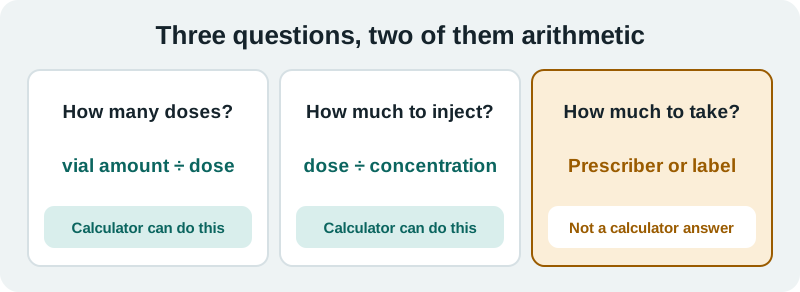
How many doses: vial amount ÷ dose. A 5 mg vial at 250 mcg per dose works out to 20.
How much to inject: dose ÷ concentration gives the volume in mL. Multiply by 100 for the mark on a U-100 syringe.
How much to take: this has to come from a licensed healthcare professional or authorized product labeling. A calculator starts from that number and cannot supply it.
The amounts below are examples chosen to make the math easy to follow. They are not suggested doses.
Peptide Calculator: How Many Doses Per Vial?
The doses-per-vial figure depends on two numbers, the total in the vial and the amount per dose. Convert them to the same unit, then divide:
doses per vial = vial amount ÷ dose
5 mg = 5,000 mcg, and 5,000 mcg ÷ 250 mcg = 20
Water does not appear in this formula. Adding 1 mL or 3 mL changes the concentration, but the vial still holds the same total. Our guide on how much BAC water to add shows that effect side by side.
| Dose | 5 mg vial | 10 mg vial | 30 mg vial |
|---|---|---|---|
| 250 mcg | 20 | 40 | 120 |
| 500 mcg | 10 | 20 | 60 |
| 1 mg | 5 | 10 | 30 |
| 2.5 mg | 2 | 4 | 12 |
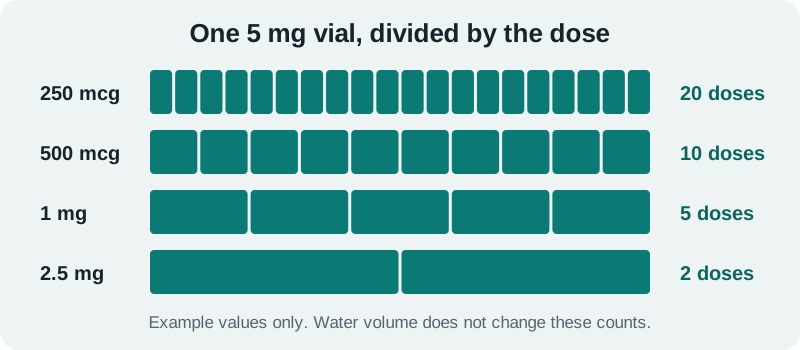
When the division leaves a remainder, count only the full doses, which is how our calculators round. A 5 mg vial at 2 mg per dose gives 2.5 on paper and two full doses in practice.
If the dose changes partway through a vial, subtract what has been used and divide the remainder by the new amount. From a 10 mg vial, four draws of 500 mcg use 2 mg. The remaining 8 mg gives eight draws at 1 mg each, or 12 draws overall.
Why the Real Number of Doses Can Be Lower
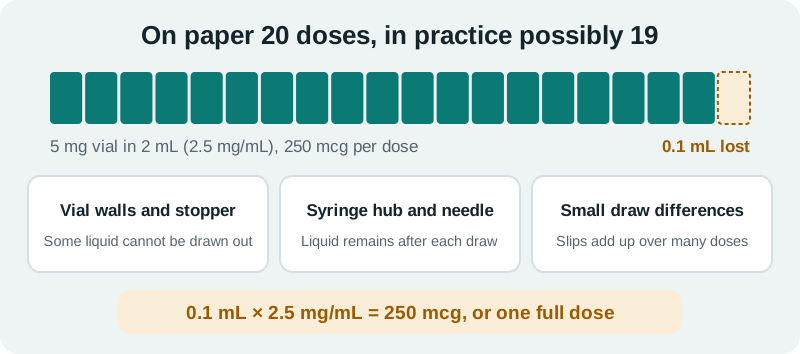
The result is a ceiling, so treat it as the most the vial could yield on paper. Some liquid stays behind on the vial walls, around the stopper, and in the syringe hub and needle. Small differences in each draw add up as well.
Lost liquid costs more at higher concentrations. Take a 5 mg vial mixed with 2 mL, or 2.5 mg/mL. If 0.1 mL can't be recovered, that liquid holds 250 mcg, which is one full dose at a 250 mcg target. The count drops from 20 to 19.
Time is another limit the formula ignores. The peptide dosage calculator estimates days per vial from your schedule: 20 doses at two per week comes to 70 days. A vial may reach its discard date before it is empty, so check the labeling for storage and in-use limits. A calculator can't assess stability, sterility or potency.
Peptide Calculator: How Much to Inject in mL and Syringe Units
This is a question about volume: how much liquid contains the dose you have already been given? Four steps get you there, using the default values in the peptide calculator.
- Find the concentration. 5 mg ÷ 2 mL = 2.5 mg/mL, or 2,500 mcg/mL.
- Match the units. The dose is in mcg, so use the concentration in mcg/mL.
- Find the volume. 250 mcg ÷ 2,500 mcg/mL = 0.1 mL.
- Convert to syringe units. 0.1 mL × 100 = 10 units on a U-100 syringe.
volume (mL) = dose ÷ concentration
U-100 units = volume (mL) × 100
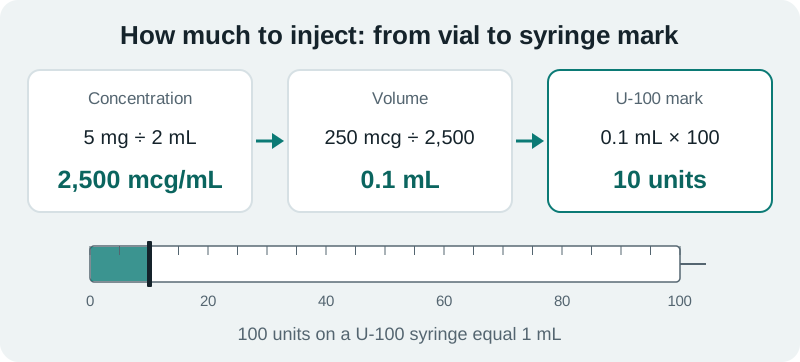
The conversion to units only holds for a U-100 syringe, where 100 units equal 1 mL. A U-40 syringe has 40 units per mL, so the same mark means a different volume. A syringe scaled in mL needs no conversion: read the mL value directly.
Sense-Check the Result Before You Rely on It
Unit errors tend to produce results that look strange, so a quick look catches many of them.
- Over 100 units: the volume is more than 1 mL. Recheck your mg and mcg entries first.
- Under 2 units: the draw is hard to measure accurately, and a unit may be wrong.
- Doses per vial below 1: the dose exceeds the whole vial, which almost always signals a wrong unit.
- A factor of 1,000: 250 mg is 1,000 times 250 mcg. Read the unit on both the vial and the instructions.
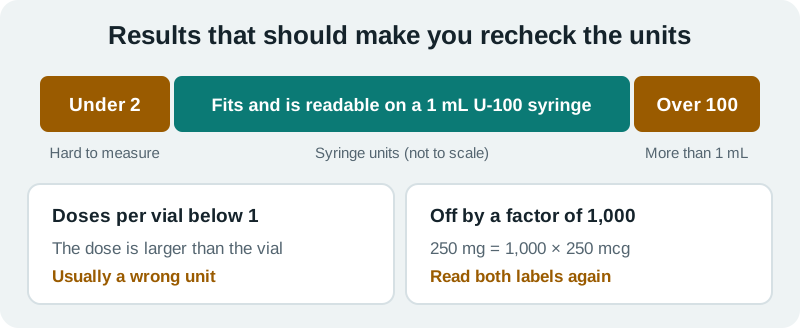
Then recalculate by hand using the steps above, or have someone else look it over. Vials with more than one peptide need separate figures for each, which the peptide blend calculator handles.
Peptide Calculator: How Much Should I Take?
A calculator cannot answer this, and we don't publish dosing charts for choosing an amount. The math is the same for every substance, while a suitable amount depends on what the substance is, why it is being used, and individual factors such as health conditions, other medications and how someone responds. None of that goes into a vial-and-water formula.
A licensed prescriber or pharmacist, or authorized labeling for the product, is the right source. Dosing figures on vendor sites, forums and social media aren't a substitute: you often can't tell where they came from or whether they fit your situation. A vial sold “for research use only” is not labeled for use in people, so it comes with no human dosing directions to follow.
A better use of the calculator is as a check. Bring the prescribed dose, the vial strength and the volume you were told to use, and ask the pharmacist to confirm the syringe mark. If you think the wrong substance or amount has been used, contact local emergency services or a poison-control service right away.
Doses Per Vial and Injection Volume FAQ
How many doses are in a 10 mg vial?
Divide 10 mg by the dose, using the same unit. At 250 mcg the math gives 40, and at 500 mcg it gives 20. The usable number can be lower because of liquid lost in the vial and syringe.
Can a peptide calculator tell me how much I should take?
No. It converts a dose you already have into a volume and syringe mark. The dose itself should come from a licensed healthcare professional or authorized product labeling.
How many mL is 10 units on a U-100 syringe?
10 units equals 0.1 mL, because 100 units on a U-100 syringe equal 1 mL.
Are syringe units the same as IU?
No. U-100 markings measure liquid volume. International Units measure biological activity and need a substance-specific definition, so one cannot be converted to the other without more information.
The Takeaway on Doses Per Vial and How Much to Inject
Get the dose from a qualified source, then let the peptide calculator handle the rest: total ÷ dose for how many doses, dose ÷ concentration for the volume, and volume × 100 for the U-100 mark. Treat the dose count as an upper limit. If you haven't settled on a water volume, start with how much BAC water to add.
This guide performs arithmetic only and is for educational purposes. It is not medical advice and does not recommend any compound, dose or schedule. Read how our formulas are checked and our medical disclaimer.