At a glance: No single BAC water volume is correct for every vial. If the product labeling or your prescriber gives a volume, use that one. Otherwise, a peptide calculator can show what each volume does to the numbers. More water leaves the peptide total unchanged. It lowers the concentration, so the same amount takes up more liquid and reaches a higher syringe mark.
The amounts below are examples chosen to make the math easy to follow. They are not suggested doses.
What a Peptide Calculator Does With the Water You Add
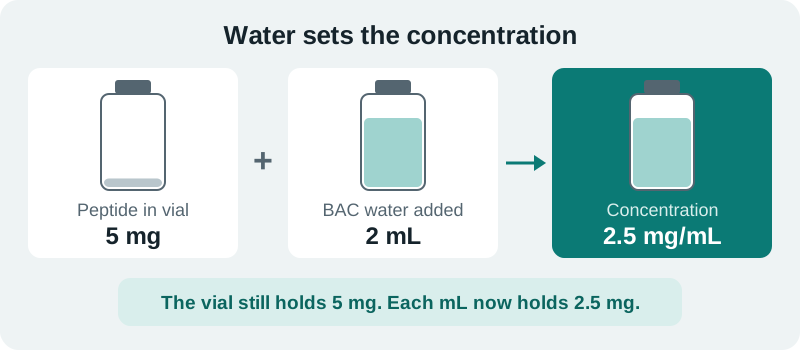
A freeze-dried vial is labeled by total weight, such as 5 mg, while a syringe measures liquid. Water links the two. Once the powder is dissolved, each millilitre holds a known share of the total:
concentration = peptide in vial ÷ water added
5 mg ÷ 2 mL = 2.5 mg/mL (2,500 mcg/mL)
The peptide calculator uses that concentration to convert a dose into a volume, then into U-100 syringe units. It treats the final volume as equal to the water you entered, so the result is only as good as your measurement. Enter the volume you actually added, not the one you planned to add.
How Much Water to Add: Comparing Volumes on the Same Vial
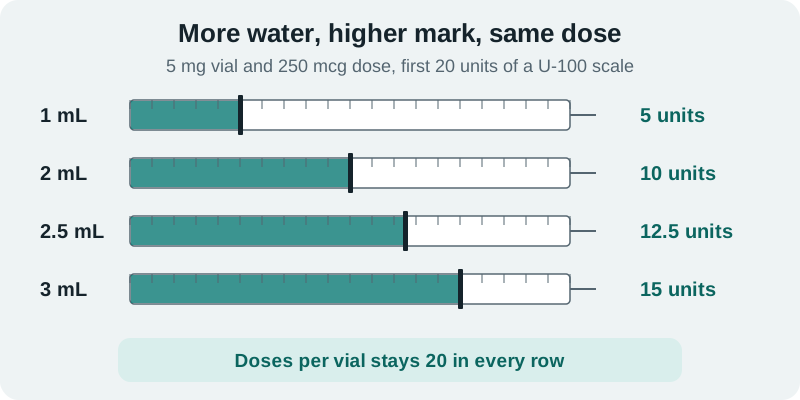
The clearest way to see the effect is to hold everything else still. This table uses the calculator's default 5 mg vial and 250 mcg dose, and changes only the water.
| Water added | Concentration | Volume per dose | U-100 mark | Doses per vial |
|---|---|---|---|---|
| 1 mL | 5 mg/mL | 0.05 mL | 5 units | 20 |
| 2 mL | 2.5 mg/mL | 0.1 mL | 10 units | 20 |
| 2.5 mL | 2 mg/mL | 0.125 mL | 12.5 units | 20 |
| 3 mL | 1.667 mg/mL | 0.15 mL | 15 units | 20 |
The syringe mark moves in step with the water: double the water and the mark doubles. The last column never moves, because the vial holds the same 5 mg throughout. Our guide to how many doses per vial covers that calculation in detail.
Why Volume Matters: How Readable the Syringe Mark Is
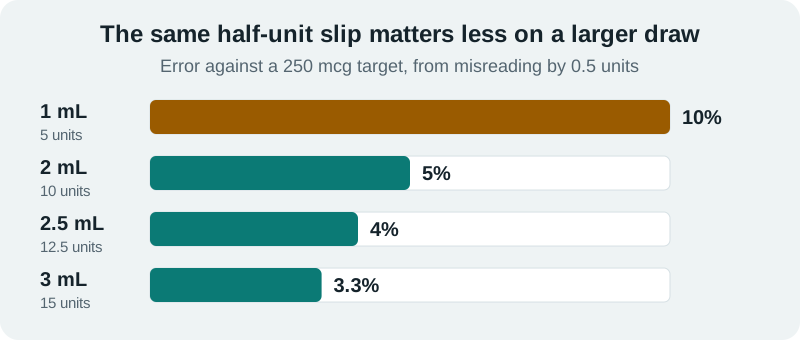
The main practical difference between these volumes is measurement error. A small draw leaves little room for a misread, because the same slip is a larger share of the total. Suppose you misjudge the plunger by half a unit, or 0.005 mL, with a 250 mcg target:
| Water added | U-100 mark | Half a unit holds | Error against target |
|---|---|---|---|
| 1 mL | 5 units | 25 mcg | 10% |
| 2 mL | 10 units | 12.5 mcg | 5% |
| 2.5 mL | 12.5 units | 10 mcg | 4% |
| 3 mL | 15 units | 8.3 mcg | 3.3% |
More water is not automatically better, though. A larger volume has to fit in the vial, and a larger draw has to fit in the syringe. Labeling or a prescriber may also specify a concentration or volume limit, and those instructions take priority over readability.
Check the syringe as well. A 0.3 mL U-100 syringe holds 30 units and a 0.5 mL holds 50. Scales differ between products, and a mark that falls between two printed lines is harder to measure than one that lands on a line.
How Much BAC Water to Add for a Specific Syringe Mark
You can also run the math backward. If you know the mark you want to compare, this formula gives the water volume that would produce it:
water (mL) = (vial mg × syringe units) ÷ (100 × dose mg)
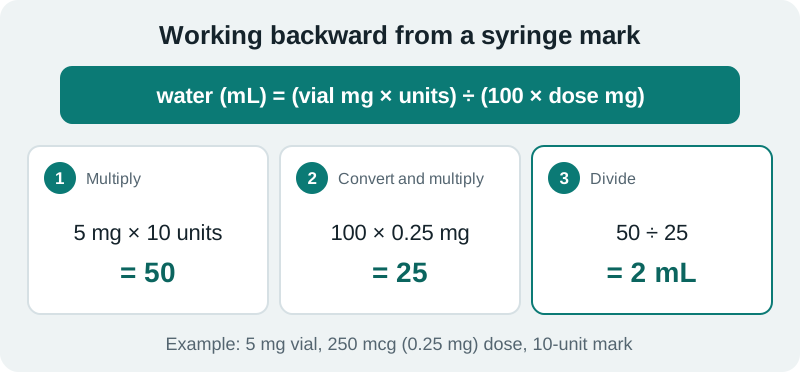
- 5 mg vial, 250 mcg dose, 10 units: (5 × 10) ÷ (100 × 0.25) = 2 mL.
- 10 mg vial, 500 mcg dose, 20 units: (10 × 20) ÷ (100 × 0.5) = 4 mL.
The peptide reconstitution calculator does this for you. The formula only solves for a number, so it says nothing about whether that volume suits the product or fits the vial.
BAC Water or Another Diluent?
The math is identical for any liquid, so a clean result does not mean the diluent is right. A calculator cannot tell you whether a diluent is compatible with a product. Take the diluent choice, storage conditions and discard date from the labeling of the products involved. If there are no directions, ask a pharmacist or prescriber before mixing.
Our BAC water guide explains what the product contains, how it differs from sterile water and when its product label says not to use it.
Common Mistakes When Entering Water Volume
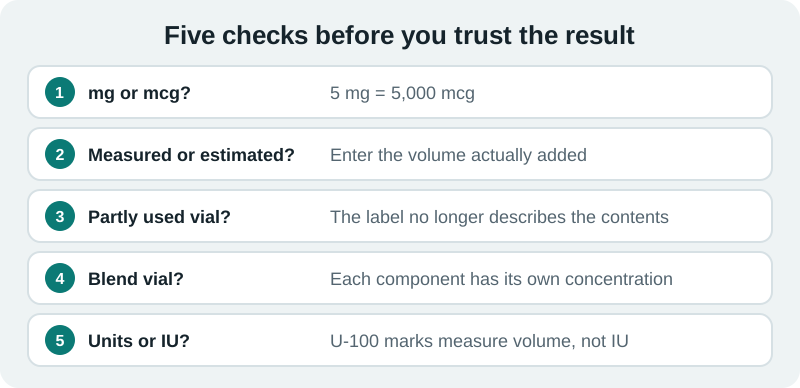
- Mixing up mg and mcg. 5 mg is 5,000 mcg. A wrong unit shifts every result by a factor of 1,000.
- Estimating the volume. If you added “about 2 mL”, the concentration is only about right too, and so is every result after it.
- Adding water to a partly used vial. The label no longer describes what is inside. The concentration has to be worked out from the amount and volume remaining.
- Entering a blend's combined weight. Each component has its own concentration. Use the peptide blend calculator for these vials.
- Reading syringe units as IU. U-100 markings measure volume, where 100 units equal 1 mL. They are not International Units.
How Much BAC Water FAQ
Does adding more BAC water reduce the amount of peptide in the vial?
No. The total stays the same. More water lowers the concentration, so the same dose takes up more volume.
Does the amount of water change how many doses are in a vial?
Not mathematically. Doses per vial equals the vial amount divided by the dose, and water volume is not part of that calculation.
Can a peptide calculator tell me how much water to add?
It can show the volume that matches a syringe mark, and you can test several volumes to compare them. It cannot tell you whether a volume or diluent is appropriate for a product.
What if the formula gives an awkward volume?
Round to a volume you can measure, then enter that exact volume in the peptide calculator to confirm the units. Do not reuse the units from before you rounded.
The Takeaway on How Much BAC Water to Add
Start with any volume the labeling or your prescriber specifies. A peptide calculator then shows what that volume means in concentration and syringe units, and lets you compare alternatives for the same vial and dose. Next, read how many doses a vial holds and how much to inject.
This guide performs arithmetic only and is for educational purposes. It is not medical advice and does not recommend any compound, dose or preparation method. Read how our formulas are checked and our medical disclaimer.