At a glance: This diluent contains benzyl alcohol to inhibit bacterial growth in a multi-dose container. That preservative does not make a contaminated vial safe. Its suitability depends on the medication's own instructions, the diluent label, and the patient. It is not an injection by itself or a substitute for clinical advice.
What Is BAC Water?
Bacteriostatic Water for Injection, USP, is the full product name. A current DailyMed product label describes sterile, nonpyrogenic water with benzyl alcohol added as a bacteriostatic preservative. The same label lists a 30 mL product containing 0.9% benzyl alcohol and a different 20 mL presentation containing 1.1%. The printed concentration on the actual vial is the one that matters.
“Bacteriostatic” means the preservative helps limit bacterial growth. It does not sterilize a contaminated product, protect against every organism, or prove that a prepared medication is safe to use. The CDC's multi-dose vial guidance says antimicrobial preservatives provide incomplete protection against bacterial contamination and no protection against viruses. Any questionable vial should be assessed according to clinical policy and discarded when sterility is in doubt.
What Is BAC Water Used For?
It is a diluent for certain drugs that must be dissolved or diluted before injection. The diluent's own label does not authorize it for every medication. The manufacturer labeling directs users to follow the drug manufacturer's instructions for the choice of vehicle, volume, route, and rate. A pharmacist or other qualified professional can resolve compatibility questions.
The water alone is not a treatment. The cited label warns against intravenous administration without a solute because it may cause hemolysis. It also states that benzyl-alcohol-containing preparations should not be used for fluid replacement. These are product safety limits, not mixing directions.
BAC Water vs. Sterile Water for Injection
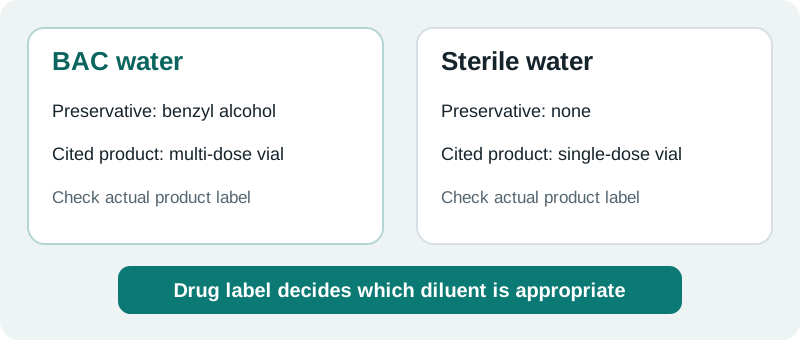
The key difference is the preservative. Bacteriostatic water contains benzyl alcohol in the cited multi-dose product. Sterile Water for Injection is preservative-free in the cited label and is supplied for single-dose use. Neither name by itself tells you whether it is compatible with a particular medicine.
| Label feature | BAC water | Sterile water for injection |
|---|---|---|
| Preservative | Benzyl alcohol in the cited product | None in the cited product |
| Container | Multi-dose presentation | Single-dose presentation |
| Choice for a medicine | Follow that medicine's labeling and a qualified professional's direction | |
A preservative-free product is not automatically interchangeable with a preserved one, and a multi-dose container is not permission to reuse needles or syringes. The CDC injection safety guidance requires a sterile needle and syringe each time a multi-dose vial is accessed.
How Long Does BAC Water Last After Opening?
There is no universal shelf-life answer for every brand and situation. Start with the specific vial's manufacturer instructions and expiration date. For a multi-dose vial that has been punctured, CDC guidance states a 28-day discard interval unless the manufacturer specifies a different period; the opened-vial date must never go beyond the original expiration date. Date the vial when it is first accessed under the applicable clinical procedure.
That guidance concerns the opened diluent vial. It does not establish how long a medication mixed with this water remains stable or sterile. The mixed drug's own labeling, compounding conditions, and professional instructions control its beyond-use date. Do not infer a new shelf life from the preservative or from an online calculator.
How Should BAC Water Be Stored?
Storage requirements depend on the exact product. The cited Hospira product label specifies controlled room temperature at 20–25°C (68–77°F). Check the label on the vial you actually have before storing it; do not assume every product uses the same temperature range. A reconstituted medicine may have entirely different storage requirements.
When Is BAC Water Not Appropriate?
The cited product label prominently says it must not be used in neonates because benzyl alcohol can be toxic in this group. It also cautions that some injectable drugs may be incompatible with the vehicle or its preservative. The suitability of any diluent depends on the patient and the drug product, so the drug's instructions and professional judgment take priority over a generic guide.
Do not use a vial when sterility is compromised or questionable. The CDC recommends storing multi-dose vials according to the manufacturer and discarding them if contamination is suspected. If a product's appearance or label raises doubt, a pharmacist can help interpret the product-specific instructions.
Where a BAC Water Calculator Fits
Our diluent calculator handles mathematical concentration and volume relationships: mass divided by volume gives concentration, and mass divided by a target concentration gives a theoretical volume. These equations cannot establish drug compatibility, sterility, a dose, or a beyond-use date. For related arithmetic, see the concentration calculator and reconstitution calculator.
If you are checking a prescribed amount in syringe units, the peptide calculator shows the unit conversion after you enter the vial amount and volume. Read how our formulas are checked and our medical disclaimer before relying on any result.
BAC Water FAQ
Is BAC water the same as sterile water?
No. The bacteriostatic product contains a preservative; the cited Sterile Water for Injection product does not. Follow the medication's label for the correct diluent.
Does BAC water kill all bacteria?
No. Its preservative inhibits growth but does not make contamination harmless or guarantee sterility.
Can BAC water be used for every injectable drug?
No. Compatibility is drug-specific. Check that drug's manufacturer instructions and ask a qualified professional.
Is the 28-day rule the shelf life of a mixed medicine?
No. CDC's general opened multi-dose vial guidance is separate from the beyond-use date of a reconstituted medication.
Sources and Editorial Note
This guide was checked against the DailyMed bacteriostatic water label, the DailyMed sterile water label, and CDC multi-dose vial guidance on October 17, 2026. Product labels may change. This is educational information, not personal medical advice or a medication preparation protocol.