How the Peptide Reconstitution Calculator Works
Freeze-dried (lyophilized) peptides arrive as a powder, and the amount of water you add decides how strong the solution is. Most tools ask you to guess a water volume and then tell you the units. This one works in the opposite direction: you choose the units you want to draw, and it solves for the water.
water (mL) = vial (mg) × target units ÷ (100 × dose (mg))
The 100 is the number of units in one millilitre on a U-100 insulin syringe. Once the vial is mixed, you can confirm any dose on the main peptide calculator, which takes the water volume as an input instead.
Peptide Reconstitution Steps
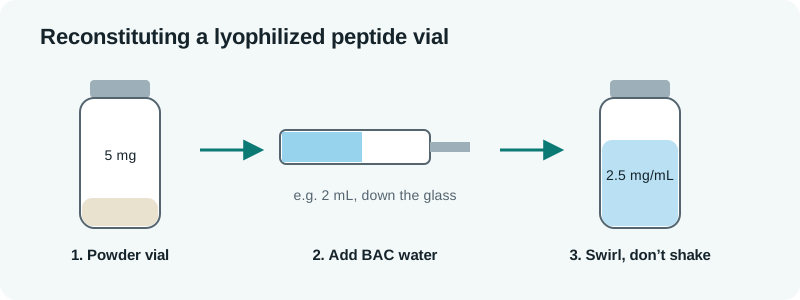
- Calculate the water first. Run your numbers through the calculator above and note the result in mL.
- Let the vial reach room temperature. Cold powder dissolves more slowly and can foam.
- Clean both stoppers. Wipe the peptide vial and the water vial with an alcohol swab and let them dry.
- Draw the water. Use a sterile syringe to draw the exact volume of bacteriostatic water the calculator gave you.
- Add it slowly down the glass. Aim the stream at the inside wall of the vial, not directly onto the powder.
- Swirl gently. Roll the vial between your fingers until the solution is clear. Do not shake it.
- Label and refrigerate. Write the date and concentration (mg/mL) on the vial and store it as the product instructions direct.
Ask your pharmacist or prescriber which diluent your product requires. Some peptides call for sterile water or another solvent instead of bacteriostatic water, and the product label always takes priority over a general guide.
Peptide Reconstitution Calculator Example
You have a 10 mg vial, your dose is 500 mcg, and you would like each dose to be 20 units because that mark is easy to read. The peptide reconstitution calculator finds the water like this:
- Dose in mg: 500 mcg = 0.5 mg.
- Water: 10 mg × 20 ÷ (100 × 0.5) = 4 mL.
- Check: 10 mg ÷ 4 mL = 2.5 mg/mL; 0.5 mg ÷ 2.5 = 0.2 mL = 20 units.
- Doses per vial: 10 mg ÷ 0.5 mg = 20.
Wanted 10 units instead? Halve the water to 2 mL. Every time you double the target units, the water doubles too, so you can trade a stronger solution for a smaller injection volume.
Choosing a Reconstitution Water Volume
There is no single correct amount of water. The best volume is the one that makes your dose easy and accurate to measure. These rules of thumb help:
Small doses: more water
If your dose comes out under 5 units, add more water so each dose spreads over more marks on the syringe.
Large doses: less water
If the dose fills most of a 1 mL syringe, use less water for a stronger solution and a smaller injection.
Vial capacity
Common vials hold 3 mL to 10 mL. Check yours before planning a large volume of water.
The table inside the calculator shows your exact dose at 1, 1.5, 2, 2.5, 3 and 5 mL of water. It lets you compare options side by side before you open a vial.
Peptide Reconstitution Calculator Chart
For quick reference, here are the concentrations produced by common vial sizes and water volumes. Divide the concentration in mcg/mL by 100 to get mcg per unit.
| Vial | 1 mL water | 2 mL water | 3 mL water | 5 mL water |
|---|---|---|---|---|
| 2 mg | 2 mg/mL | 1 mg/mL | 0.667 mg/mL | 0.4 mg/mL |
| 5 mg | 5 mg/mL | 2.5 mg/mL | 1.667 mg/mL | 1 mg/mL |
| 10 mg | 10 mg/mL | 5 mg/mL | 3.333 mg/mL | 2 mg/mL |
| 15 mg | 15 mg/mL | 7.5 mg/mL | 5 mg/mL | 3 mg/mL |
| 20 mg | 20 mg/mL | 10 mg/mL | 6.667 mg/mL | 4 mg/mL |
Once you know the concentration, the peptide dosage calculator converts any dose into units and tells you how long the vial will last at your dosing frequency.
Common Peptide Reconstitution Mistakes
- Mixing up mg and mcg. A 250 mcg dose is 0.25 mg. Entering 250 mg would put the water off by a factor of 1,000, so check the unit selector.
- Forgetting what was added. Label the vial right away. Without the water volume, no calculator can tell you the units.
- Shaking the vial. Vigorous shaking can damage fragile peptide chains. Swirl or roll instead.
- Using too little water for tiny doses. A 1-unit draw is very hard to measure. Pick a volume that puts the dose at 5 units or more.
Peptide Reconstitution Calculator FAQ
How much bacteriostatic water should I add to a peptide vial?
It depends on your dose and the units you want to draw. Multiply the vial mg by your target units, then divide by 100 times the dose in mg. A 5 mg vial, a 250 mcg dose and 10 units needs 2 mL.
Does reconstitution water change the peptide dose?
No. The water only sets the concentration. The peptide in each dose stays the same; only the number of units you draw changes.
Can I use this peptide reconstitution calculator for any vial size?
Yes. Enter any amount in mg or mcg. The formula works for 1 mg vials and 30 mg vials alike, as long as the result fits your vial and syringe.
What if the peptide reconstitution result is an awkward number?
Round the water to a volume you can measure, such as 2.5 mL, then confirm the exact units on the main peptide calculator using that water volume.
Is the reconstitution calculator free to use?
Yes. It is free, needs no sign-up, and runs only in your browser.
This peptide reconstitution calculator is an arithmetic aid for educational purposes, not medical advice. Follow the product label and the instructions of a licensed healthcare professional. See our medical disclaimer and how our formulas are checked. For product labelling of bacteriostatic water, search DailyMed (U.S. National Library of Medicine).