How the Peptide Molecular Weight Calculator Works
Each peptide bond joins two amino acids and releases one water molecule. A peptide is therefore the sum of its residues (each amino acid minus water) plus one water for the two free ends. The calculator adds up the elemental formula first, then converts it to mass, so the formula and both masses always agree.
MW = Σ residue masses + H₂O (18.02)
acetyl N-terminus: + C₂H₂O (+42.04)
amide C-terminus: −OH +NH₂ (−0.98)
each disulfide bond: −2H (−2.016)
Average vs Monoisotopic Peptide Mass
Average molecular weight
Uses the natural mix of isotopes for each element. Use it for weighing powder, molarity and anything done by mass on a balance.
Monoisotopic mass
Uses only the most common isotope (¹²C, ¹H, ¹⁴N, ¹⁶O, ³²S). Use it to match the first peak in a high-resolution mass spectrum.
For small peptides the two differ by less than 1 Da; for a 50-residue peptide the gap grows to about 3 Da. A peptide mass calculator that reports only one of them can mislead you in the other setting, so this one shows both.
Peptide Molecular Weight Calculator Example
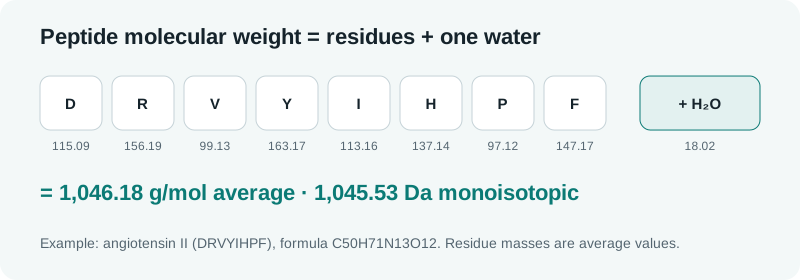
Angiotensin II has the sequence DRVYIHPF with free ends:
- Residue sum (average): 115.09 + 156.19 + 99.13 + 163.17 + 113.16 + 137.14 + 97.12 + 147.17 = 1,028.17.
- Add one water: 1,028.17 + 18.02 = 1,046.18 g/mol (rounding of the shown values aside).
- Formula: C50H71N13O12. Monoisotopic mass: 1,045.5345 Da, so [M+H]+ appears at m/z 1,046.54.
Oxytocin (CYIQNCPLG) shows the modifications at work: with its C-terminal amide and one disulfide bond, the result is C43H66N12O12S2 at 1,007.19 g/mol. Click the presets above to check both.
Calculate MW of a Peptide with Modifications
- N-terminal acetylation caps the free amine and adds 42.04 g/mol. It also removes a positive charge.
- C-terminal amidation swaps –OH for –NH₂, lowering the mass by 0.98 g/mol and removing a negative charge.
- Disulfide bonds each remove two hydrogens. The calculator caps the count at half the cysteines in the sequence.
Other modifications (phosphorylation, PEG, fluorescent labels, unnatural amino acids) are not included. Add their mass change by hand: phosphorylation is +79.97 Da per site, for example.
Amino Acid Residue Masses
The values the calculator uses, as residues (amino acid minus water):
| Amino acid | Code | Residue formula | Average | Monoisotopic |
|---|---|---|---|---|
| Alanine | A | C3H5NO | 71.08 | 71.0371 |
| Arginine | R | C6H12N4O | 156.19 | 156.1011 |
| Asparagine | N | C4H6N2O2 | 114.10 | 114.0429 |
| Aspartic acid | D | C4H5NO3 | 115.09 | 115.0269 |
| Cysteine | C | C3H5NOS | 103.14 | 103.0092 |
| Glutamic acid | E | C5H7NO3 | 129.11 | 129.0426 |
| Glutamine | Q | C5H8N2O2 | 128.13 | 128.0586 |
| Glycine | G | C2H3NO | 57.05 | 57.0215 |
| Histidine | H | C6H7N3O | 137.14 | 137.0589 |
| Isoleucine | I | C6H11NO | 113.16 | 113.0841 |
| Leucine | L | C6H11NO | 113.16 | 113.0841 |
| Lysine | K | C6H12N2O | 128.17 | 128.0950 |
| Methionine | M | C5H9NOS | 131.20 | 131.0405 |
| Phenylalanine | F | C9H9NO | 147.17 | 147.0684 |
| Proline | P | C5H7NO | 97.12 | 97.0528 |
| Serine | S | C3H5NO2 | 87.08 | 87.0320 |
| Threonine | T | C4H7NO2 | 101.10 | 101.0477 |
| Tryptophan | W | C11H10N2O | 186.21 | 186.0793 |
| Tyrosine | Y | C9H9NO2 | 163.17 | 163.0633 |
| Valine | V | C5H9NO | 99.13 | 99.0684 |
Element masses follow IUPAC standard atomic weights for the average values and the most abundant isotope for the monoisotopic values. You can cross-check published peptides in the PubChem database (NIH).
Using Molecular Weight in the Lab
Once you have the molecular weight, the peptide concentration calculator converts mg/mL into millimolar and micromolar. To find the net charge, isoelectric point and a solubility starting point for the same sequence, use the peptide net charge calculator.
Peptide Molecular Weight Calculator FAQ
How do you calculate the molecular weight of a peptide?
Add the residue mass of every amino acid in the sequence, then add 18.02 g/mol for one water molecule. Adjust for terminal modifications and subtract 2.016 for each disulfide bond.
Is a peptide MW calculator the same as a peptide mass calculator?
Molecular weight usually means the average mass in g/mol. Peptide mass in mass spectrometry usually means the monoisotopic mass in Da. This calculator reports both.
Why is my vial heavier than the calculated molecular weight suggests?
Lyophilized peptides contain counter-ions such as TFA or acetate and some water. The molecular weight here is for the free peptide; the certificate of analysis gives the net peptide content.
Can I enter three-letter amino acid codes?
No. Use one-letter codes (A, R, N, D…). Spaces, numbers and dashes are ignored, and any other letter is flagged.
Is the peptide molecular weight calculator free?
Yes. It is free, needs no account, and the sequence you enter never leaves your browser.
This calculator is a research and educational tool. Results assume standard L-amino acids and the modifications listed; confirm critical values against your certificate of analysis. See how the formulas are checked. Working with a reconstituted vial instead? The main peptide calculator converts doses into syringe units, and the peptide dilution calculator makes working solutions from a stock.