What Is TDEE?
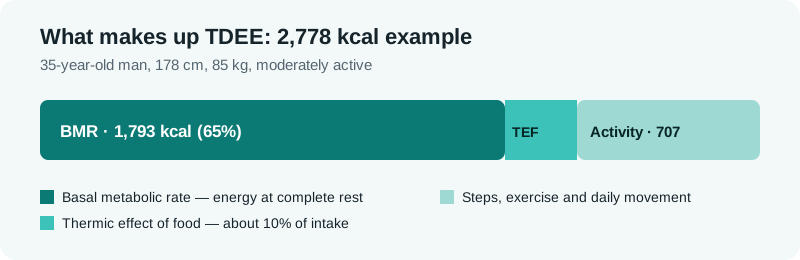
TDEE stands for total daily energy expenditure. It is the sum of everything your body burns in 24 hours: the energy needed to keep you alive at rest (your basal metabolic rate, or BMR), the energy used to digest food, and the energy spent moving — from workouts to walking around the house.
Knowing your TDEE is the starting point for any calorie plan. Eat roughly at your TDEE and your weight stays stable; eat below it and you lose weight; eat above it and you gain. This tool gives you that baseline in seconds instead of weeks of food logging.
How the TDEE Calculator Works
The calculator uses the Mifflin-St Jeor equation, published in 1990 and widely regarded as one of the most accurate formulas for estimating resting energy expenditure in healthy adults (Mifflin et al., American Journal of Clinical Nutrition).
TDEE step 1: BMR
Men: BMR = 10 × weight (kg) + 6.25 × height (cm) − 5 × age + 5
Women: BMR = 10 × weight (kg) + 6.25 × height (cm) − 5 × age − 161
TDEE step 2: activity factor
TDEE = BMR × activity factor
The activity factors run from 1.2 for a sedentary lifestyle to 1.9 for very physical work plus training. Most people overestimate their activity, so if you are unsure between two levels, choose the lower one.
TDEE Calculator with Steps
Picking an activity level is guesswork, and most people pick one level too high. If you wear a phone or watch that counts steps, a TDEE calculator with steps is more objective. Enter your average daily steps over the last week and the calculator selects the activity factor from published pedometer bands (Tudor-Locke & Bassett, Sports Medicine):
| Daily steps | Step category | Activity factor |
|---|---|---|
| Under 5,000 | Sedentary | 1.2 |
| 5,000–7,499 | Low active | 1.375 |
| 7,500–9,999 | Somewhat active | 1.55 |
| 10,000–12,499 | Active | 1.725 |
| 12,500 or more | Highly active | 1.9 |
Steps capture walking well but miss cycling, swimming and weight training. If you do a lot of those, compare the step-based result with the activity-level result and lean towards the higher one.
TDEE Calculator Example
A 35-year-old man who is 178 cm tall, weighs 85 kg and exercises three to five days a week:
- BMR: 10 × 85 + 6.25 × 178 − 5 × 35 + 5 = 1,793 kcal.
- TDEE: 1,793 × 1.55 = 2,778 kcal per day.
- Weight loss target: 2,778 − 500 = 2,278 kcal, which typically leads to around 0.5 kg (1 lb) of loss per week.
Treat the result as an estimate. Track your weight for two to three weeks at the suggested intake, and adjust by 100–200 kcal if the scale moves faster or slower than expected.
Using Your TDEE for Weight Loss
A deficit of 250–500 kcal below TDEE is a sustainable range for most adults. Bigger deficits speed up early weight loss but make it harder to keep muscle, sleep well and stick with the plan. As a general safety floor, intakes below about 1,200 kcal a day for women or 1,500 kcal for men should only be followed under medical supervision; the calculator warns you if a target drops below that.
Your TDEE also falls as you lose weight, because a smaller body burns less energy. Recalculate after every 4–5 kg (about 10 lb) of change so your target stays accurate.
Adaptive TDEE Calculator
Formulas estimate; your own data measures. An adaptive TDEE calculator works backwards from what actually happened: how much you ate on average and how your weight changed. Every kilogram of body weight change represents roughly 7,700 kcal, so:
adaptive TDEE = average daily intake − (weight change (kg) × 7,700 ÷ days)
Your measured TDEE is 2,475 kcal per day
- Daily energy balance−275 kcal
- Weight change per week−0.25 kg
- Target for −500 kcal1,975 kcal
For a reliable adaptive result, log food consistently for at least 3–4 weeks and compare weekly average weights, not single weigh-ins, because daily water swings of 1–2 kg are normal. Re-run it every month: as your weight and habits change, your adaptive TDEE changes too.
TDEE Calculator for GLP-1 Users
People using GLP-1 based medicines often eat far less than before because appetite drops sharply. That makes it easy to fall well below TDEE and short on protein, which raises the risk of losing muscle along with fat. Many clinicians suggest aiming for roughly 1.2–1.6 g of protein per kg of body weight while losing weight; the calculator shows that range for you.
If you are measuring a peptide yourself, our peptide calculator converts doses into syringe units, the peptide dosage calculator shows how long a vial lasts, and the retatrutide peptide calculator covers that investigational compound. Always follow your prescriber's plan for both medication and nutrition.
TDEE Calculator FAQ
How accurate is a TDEE calculator?
For most healthy adults, Mifflin-St Jeor estimates resting needs within about 10%. Real-world tracking over a few weeks is the best way to fine-tune the number.
Should I eat my TDEE calories to lose weight?
No. Eating at TDEE maintains your weight. To lose weight, eat 250–500 kcal below it; the calculator shows both targets.
What is the difference between BMR and TDEE?
BMR is the energy you burn at complete rest. TDEE adds digestion and all daily movement, so it is always higher than BMR.
Is a TDEE calculator with steps more accurate?
Usually, because step counts are measured rather than guessed. It can underestimate people whose training is mostly cycling, swimming or lifting, since those barely register as steps.
What is an adaptive TDEE calculator?
It calculates TDEE from your real average intake and weight change over several weeks, instead of from a formula. It automatically accounts for your individual metabolism and activity.
Does the TDEE calculator work for athletes?
It works as a starting point. Very muscular people burn more than the formula predicts, so they may need to adjust upward after tracking.
This TDEE calculator gives estimates for healthy adults and is for educational purposes only. It is not medical or dietetic advice. If you are pregnant, under 18, have a medical condition or take weight-loss medication, plan your intake with a doctor or registered dietitian. See our medical disclaimer and how our formulas are checked.