How to Use the Peptide Calculator
You need three numbers from your vial label and your plan. The tool handles the unit conversions, so you never have to move a decimal point by hand.
- Enter the vial amount. This is the total peptide printed on the label, usually in mg (for example 5 mg or 10 mg). Use the mcg option if the label lists micrograms.
- Enter the water you added. Type the millilitres of bacteriostatic water used to reconstitute the powder. More water means a weaker solution and more units per dose.
- Enter your dose. Type the amount prescribed or planned for one injection, in mcg or mg.
- Pick your syringe. The calculator warns you if the draw does not fit, or if it is too small to measure well.
- Read the result. The large number is how many units to pull on the syringe. The drawing shows roughly where the plunger should sit.
Have not mixed the vial yet? Plan the water first with the peptide reconstitution calculator, which works backwards from the units you want to draw.
Peptide Calculator Formula
The arithmetic takes three steps. Knowing it lets you double-check any result on paper.
1. Peptide concentration
concentration (mg/mL) = peptide in vial (mg) ÷ water added (mL)
2. Peptide volume per dose
volume (mL) = dose (mg) ÷ concentration (mg/mL)
3. Peptide dose in syringe units
units = volume (mL) × 100
The factor of 100 comes from the U-100 insulin syringe: one millilitre is divided into 100 units, so each unit holds 0.01 mL. It is the standard syringe for small subcutaneous volumes, and the one this page assumes.
Peptide Calculator Example: 5 mg Vial
Say you have a 5 mg vial, you add 2 mL of bacteriostatic water, and your dose is 250 mcg. Here is the working:
- Concentration: 5 mg ÷ 2 mL = 2.5 mg/mL, which is 2,500 mcg per mL.
- Volume: 0.25 mg ÷ 2.5 mg/mL = 0.10 mL.
- Units: 0.10 mL × 100 = 10 units on a U-100 syringe.
- Doses per vial: 5 mg ÷ 0.25 mg = 20 doses.
If you had added 1 mL instead, the same 250 mcg dose would be 5 units. Less water gives a stronger solution and a smaller draw. With 3 mL it would be 15 units. The peptide dose is identical in all three cases — only the volume changes.
Peptide Calculator mg and mcg Conversions
Most mistakes happen when a vial is labelled in mg but the dose is written in mcg. The calculator handles the switch automatically, but this quick table helps you sanity-check it:
| mg | mcg | Units at 2.5 mg/mL | Units at 5 mg/mL |
|---|---|---|---|
| 0.1 mg | 100 mcg | 4 units | 2 units |
| 0.25 mg | 250 mcg | 10 units | 5 units |
| 0.5 mg | 500 mcg | 20 units | 10 units |
| 1 mg | 1,000 mcg | 40 units | 20 units |
| 2.5 mg | 2,500 mcg | 100 units | 50 units |
A 2.5 mg/mL solution is a 5 mg vial with 2 mL of water; 5 mg/mL is a 10 mg vial with 2 mL. For anything outside this table, use the tool above — it accepts any mg or mcg value.
Peptide Calculator Syringe Units Chart
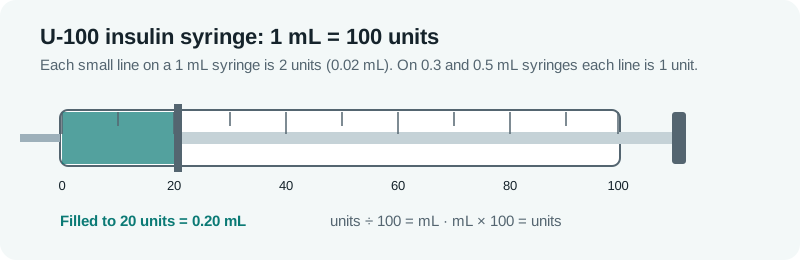
Units are a volume mark on the syringe, not a measure of peptide. Ten units always means 0.10 mL, whatever is in the vial. That is why the concentration matters: the same 10 units can hold 250 mcg in one vial and 500 mcg in another. For a refresher on handling an insulin syringe, MedlinePlus has a clear guide to giving an insulin injection.
Peptide Calculator Accuracy Tips
The math is exact, but the draw is only as good as the inputs. A few habits keep results meaningful in practice:
- Aim for 5–50 units per dose. Draws under 2–3 units are hard to read. If your result is tiny, add more water when you next reconstitute.
- Match the syringe to the draw. A 0.3 mL syringe has 1-unit lines, so small doses are easier to measure than on a 1 mL barrel.
- Write the concentration on the vial. Once mixed, label the vial with mg/mL so you never have to remember how much water went in.
- Re-check the label. Some vials state total content per vial and others per pack. Enter the amount in the vial you are actually using.
Planning a weekly schedule? The peptide dosage calculator adds dosing frequency and shows how many days a vial will last.
Other Peptide Calculators on This Site
Peptide reconstitution calculator
Works out how much bacteriostatic water to add so each dose lands on a round, easy-to-read number of units.
Peptide dosage calculator
Converts a dose into units and mL, then shows doses per vial, days of supply and a dose-to-units table.
Retatrutide peptide calculator
The same math with retatrutide vial presets, plus a units-per-mg chart. Arithmetic only, no dose advice.
TDEE calculator
Estimates daily calorie burn, weight-loss targets and a protein range to pair with your plan.
Peptide Calculator FAQ
How does a peptide calculator convert mg to units?
It divides the vial's mg by the water added to get mg per mL, divides your dose by that concentration to get mL, then multiplies by 100 because a U-100 syringe has 100 units per mL.
Is this peptide calculator free?
Yes. It is free, needs no account, and runs entirely in your browser, so the numbers you enter are never sent to a server.
Does more water change the peptide dose?
No. Water only changes the concentration. With more water you draw more units for the same peptide dose; with less water you draw fewer units.
Can the peptide calculator handle blends?
Yes, if you calculate one component at a time. Enter that component's mg in the vial and its dose; the units you get also deliver the other components in the same ratio as the blend.
Which syringe does the peptide calculator assume?
A U-100 insulin syringe, where 1 mL equals 100 units. If you use a different syringe, convert the mL result shown instead of the unit figure.
Is a peptides calculator the same as a dosage calculator?
They use the same formula. A peptides calculator usually focuses on units per injection, while a dosage calculator also adds frequency and vial supply.
This peptide calculator performs arithmetic only and is provided for educational purposes. It does not recommend any peptide, dose or protocol. Confirm every dose with a licensed healthcare professional, and read our medical disclaimer and how the formulas are checked. Compounded products are not FDA-approved; see the FDA's guidance on drug compounding.